2026-09-24 · 8
Pomsky Body Language: A Temperament Guide for New Owners
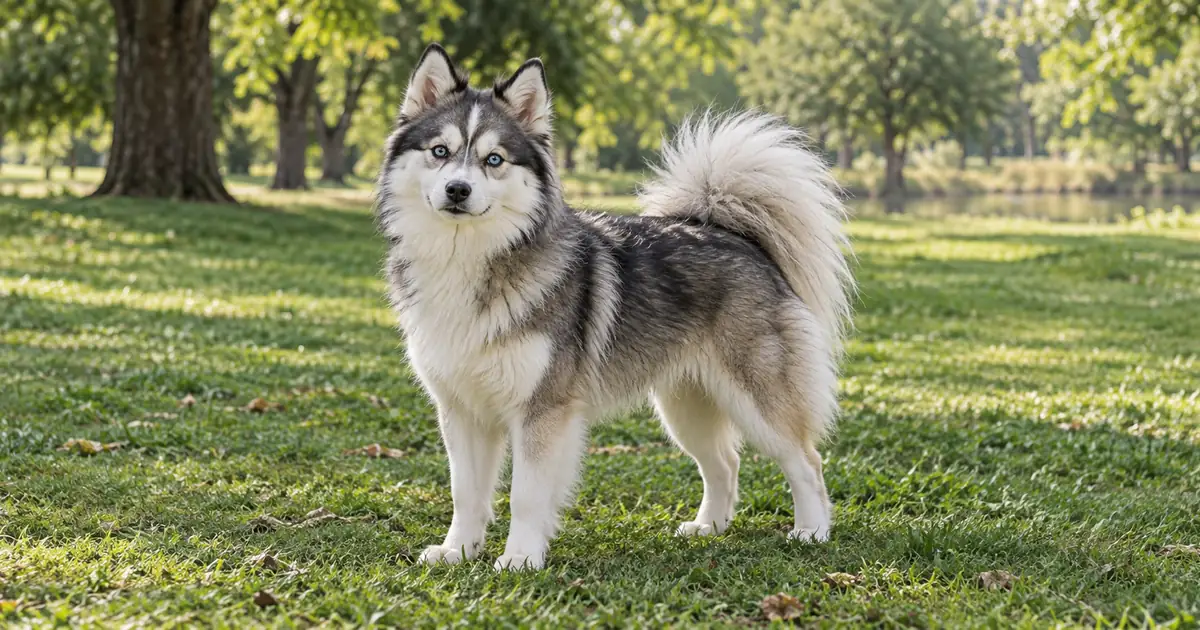
A Pomsky may look like a small husky, but appearance cannot tell you which behaviour traits will be strongest. Some are highly vocal and busy. Others are quieter, cautious, or more people-focused. Read posture, movement, facial tension, distance, and recovery together. The mixed-breed label gives you possibilities, not a reliable translation of one dog's mood.
Why Pomskies are trending
Rover's 2026 breed report placed the Pomsky first on its list of fastest-rising breeds in its US user database, with a reported 13 percent year-over-year increase. That makes the breed timely, but popularity does not make temperament more predictable.
A Pomsky is a cross involving Siberian Husky and Pomeranian ancestry. Hill's Pet Nutrition notes that there is no single breed standard for the mix's appearance or temperament. Puppies from different lines, and even littermates, can inherit very different combinations.
That uncertainty is the first thing a new owner should understand. Do not buy a photo and expect a preset personality.
Start with the individual dog
Breed ancestry can suggest questions. It cannot answer them for you.
Ask how quickly your dog becomes excited, what helps them settle, whether unfamiliar people cause approach or retreat, and how they respond when frustrated. Watch the same situations over several days rather than building a personality theory from one dramatic moment.
The complete dog body-language guide gives you the shared signals: weight distribution, muscle tension, mouth shape, eyes, ears, tail, movement, and distance. Use all of them before deciding what one bark or stare means.
A small frame can hold a lot of arousal
One common mismatch is visual. A compact, fluffy dog may be treated as easy to manage even when the dog's arousal climbs quickly.
High arousal can look like rapid movement, jumping, grabbing the leash, hard panting when it is not hot, repeated vocalizing, difficulty taking food gently, or an inability to pause. It is not automatically aggression. It means the nervous system is busy and learning may be harder in that moment.
Move away from the trigger, reduce activity, and wait for softer movement or voluntary sniffing. The dog stress-signals guide can help you spot the earlier, quieter changes that happen before behaviour becomes loud.
Vocal does not mean defiant
Pomskies may bark, whine, yip, grumble, or produce longer husky-like vocal sounds. Owners often describe this as "talking back," which is funny until the label replaces observation.
Sound can accompany excitement, frustration, alarm, social contact, play, or a request. Check what happened immediately before it. Did a door close, a person stop interacting, another dog appear, or dinner preparation begin? Then watch whether the body is loose or tense.
Our dog barking communication guide explains why pitch and repetition are only part of the message. The dog whining guide covers softer vocal behaviour and the medical or emotional contexts that may sit behind it.
Ears need context
Many Pomskies have upright ears, so changes can look obvious. Forward ears may show interest, but interest can be relaxed or intense. Ears rotated sideways or back may accompany uncertainty, appeasement, concentration, or simple listening.
Compare the ears with the mouth and body. Forward ears above a loose face and curved approach are different from forward ears above a closed mouth, fixed stare, and weight shifted toward a trigger. Flattened ears with a low body and retreat suggest a need for distance.
Use the dog ear-position guide for examples, but remember that coat, ear shape, and individual anatomy affect what you can see.
The curled tail can mislead you
Pomeranian ancestry can contribute a tail carried high or curled over the back. That resting shape does not prove confidence or happiness. It also makes some changes in height harder to notice.
Look at the base of the tail, speed and breadth of movement, and the rest of the body. A high tail with stiff, short movement can accompany tension. A sweeping wag with a loose torso is different. A suddenly lowered or tucked tail may be especially meaningful if it departs from your dog's normal carriage.
The tail-wagging communication guide explains why "wagging equals friendly" is an unsafe shortcut.
Watch the eyes and mouth
A relaxed Pomsky may have soft eyelids, an easy gaze, and a loose mouth. Stress may bring a closed mouth, repeated lip licking, a furrowed brow, rapid scanning, or the white of the eye becoming visible as the head turns away.
None of these signs should be translated alone. A dog may close their mouth because they heard a sound. A brief lip lick may follow food. Repetition and context make the signal useful.
If the dog becomes still, closes the mouth, fixes the eyes, and leans forward, create space. Do not bring a hand closer to "see what happens." The facial-expression guide and whale-eye guide show how multiple facial cues fit together.
Independence is not stubbornness
Some Pomskies disengage quickly when training becomes repetitive or the environment is more interesting than the reward. Calling the dog stubborn often leads the human to repeat cues louder while the actual problem remains unchanged.
Check four things: Can the dog perform the behaviour in a quiet room? Is the reward worth earning here? Is the session short enough? Is the dog comfortable?
Train in small steps. Ask once, reward quickly, and stop while the dog still wants another turn. If a cue falls apart outdoors, lower the difficulty by adding distance or choosing a quieter location.
The breed-specific behaviour guide explains how inherited tendencies can shape a training plan without becoming an excuse or a destiny claim.
Chase and play need careful reading
Fast movement can trigger pursuit in many dogs. A Pomsky may chase toys, birds, squirrels, cats, or running children. Play can also become intense when one dog enjoys pursuit more than the other.
Healthy social play usually includes loose bodies, pauses, role changes, and both dogs choosing to return. Interrupt when one dog repeatedly hides, tries to leave, becomes stiff, or is continually pinned without a chance to reset.
Use long lines and secure areas while you assess recall. Introduce cats and small animals slowly with barriers and supervision. A cute puppy interaction does not predict safe adult behaviour.
What an overwhelmed Pomsky may show
Early signs can include looking away, sniffing the ground out of context, slowing down, scratching, shaking off, lip licking, or moving behind a person. Later signs may include frantic movement, barking, hiding, growling, snapping, or escape attempts.
Growling is information. Punishing it may suppress a warning without changing the discomfort underneath. Increase distance and identify the trigger. If the response is frequent, escalating, or difficult to manage safely, ask a qualified positive-reinforcement trainer, veterinary behaviourist, or veterinarian for help.
Our growling communication guide explains how to respond without treating the sound as a challenge to authority.
Build a useful daily rhythm
Pomskies often benefit from a predictable balance of movement, sniffing, training, rest, and low-pressure social time. More exercise is not always the answer. Constant high-intensity activity can create an athlete who remains poor at settling.
Try one sniff-led walk, a few two-minute training sessions, food enrichment, and protected rest. Adjust the amount to age, health, and the individual dog's response. Nose-work activities can provide focused mental effort without demanding nonstop speed.
Track recovery. A useful activity leaves the dog able to rest afterward. If the dog returns more frantic and stays that way, change the duration, intensity, or environment.
When behaviour may be medical
Sudden irritability, hiding, touch sensitivity, sleep disruption, reduced appetite, reluctance to move, or a new startle response can be signs of pain or illness. Do not assume a surprising change is the Husky side or the Pomeranian side appearing.
Arrange a veterinary check when behaviour changes abruptly, especially if there are physical symptoms. Training cannot resolve untreated pain. A medical assessment and behaviour plan can work together once urgent causes are considered.
Frequently asked questions
Are Pomskies always vocal?
No. Vocal behaviour varies widely. Some bark, whine, or make long conversational sounds, while others are comparatively quiet. Learn when your dog vocalizes, what the body is doing, and how quickly the dog recovers instead of treating noise as a guaranteed breed trait.
Are Pomskies good for first-time owners?
Some can be, provided the owner is ready for mixed-breed uncertainty, regular grooming, training, enrichment, and potentially high arousal or vocal behaviour. Meet the individual dog, ask about the parents and early socialisation, and avoid choosing on appearance alone.
Why does my Pomsky ignore me outside?
The environment may be more rewarding or overwhelming than your cue. Practice indoors first, then move to a quiet outdoor space with better rewards and more distance from distractions. A failure outdoors usually means the training step is too difficult, not that the dog is plotting to disobey.
What does a curled Pomsky tail mean?
A curled or high tail may be normal anatomy and resting carriage. Read changes from that dog's baseline, including stiffness, movement at the base, wag shape, posture, mouth, and eyes. A high tail by itself does not prove confidence or friendliness.
Do Pomskies have a strong prey drive?
Some show strong interest in chasing small animals, but intensity varies. Use secure management, gradual introductions, and a long line while assessing recall. Do not assume a puppy's calm response guarantees adult safety around cats or wildlife.
Can a dog translator app tell exactly what my Pomsky means?
No app can provide a literal translation of every bark or movement. Dog Translator can help you notice sound patterns and make observation more engaging, but you still need context and whole-body signals. Health or safety concerns belong with a veterinarian or qualified behaviour professional.
A Pomsky's appearance may be the first thing people notice. Living well with one depends on something less photogenic: learning that dog's baseline and paying attention when it changes.
Try it with your dog
Record a bark, scan a dog photo, or play a sound and see what happens next.