2026-09-22 · 8
Great Pyrenees Body Language: A Guardian Dog Guide
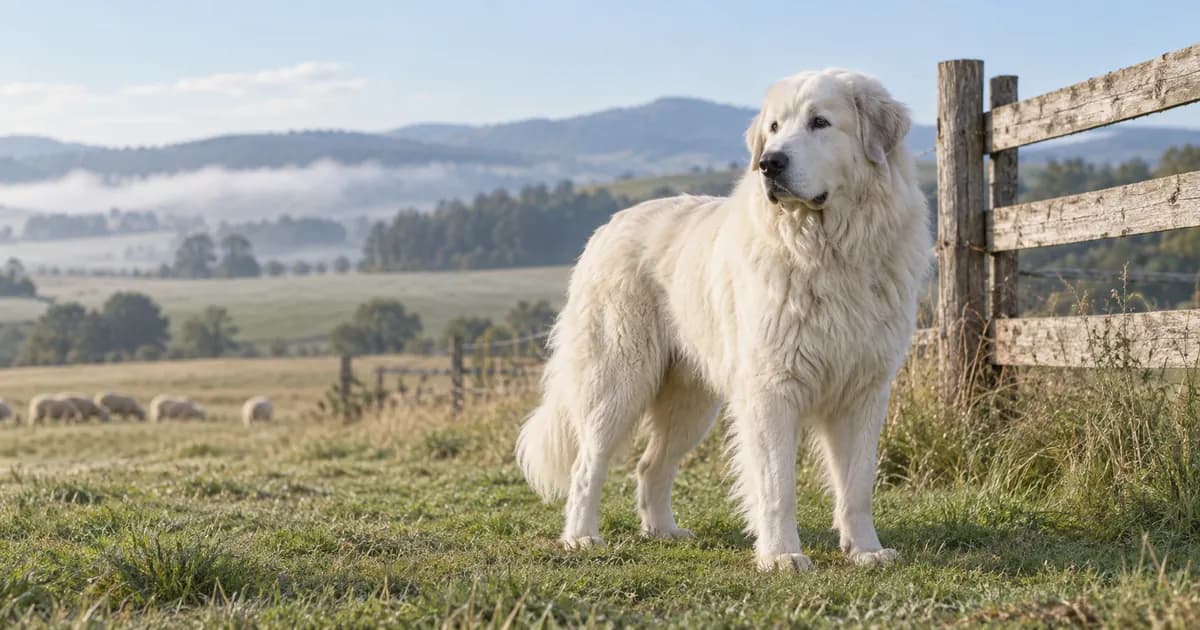
A Great Pyrenees may communicate by becoming still, placing their body between you and a concern, patrolling a boundary, or barking before you can identify a trigger. These behaviors fit a livestock guardian history, but breed does not explain every moment. Read the whole body, check the context, and treat sudden changes as possible health or stress signals.
Why this breed is easy to misread
Great Pyrenees were developed to guard livestock and make decisions without constant human direction. The American Kennel Club describes the breed as a vigilant guardian as well as a mellow companion.
That combination can surprise new owners. A Pyr may look deeply relaxed, then stand and orient toward a sound nobody else noticed. They may ignore a repeated cue while continuing to watch the fence. They may lean affectionately against a family member and later block a visitor's path.
None of those actions has one automatic translation. Guardian history supplies a useful question: "What is this dog monitoring?" It does not prove that the dog is protecting, dominating, or correctly judging a threat.
Start with the whole body
Do not interpret one tail position, bark, or stare in isolation. Look at posture, muscle tension, mouth, eyes, ears, weight distribution, movement, distance, and recovery.
A relaxed Pyr may have loose facial muscles, soft eyes, an open mouth, balanced weight, and easy movement. An alert dog may close the mouth, shift weight forward, raise the head, orient both ears, and become still. A worried dog may lean away, lower the body, lick the lips, turn the head, or seek distance.
The complete dog body-language guide gives you the shared vocabulary. This article adds the guardian-dog context.
Stillness can be information
Owners often notice noise and miss the pause before it. A Great Pyrenees may freeze briefly while assessing a distant person, animal, vehicle, or sound. That pause is not automatically aggression. It is a change in attention.
Check what follows. Does the body loosen after recognition? Can the dog turn back to you, sniff, or take food gently? Or does the posture become taller and harder, with a closed mouth and fixed gaze?
Increasing stiffness, forward weight, inability to disengage, and shrinking distance deserve careful handling. Do not test the dog by moving a stranger closer. Add distance and use a practiced cue.
The dog facial-expression guide can help you compare soft observation with a tense stare.
The body block
A Pyr may step between a family member and another person or dog. People often call this protection. Sometimes it is. The same position can also reflect uncertainty, learned crowding, attention-seeking, or an attempt to control movement.
Look for consent and flexibility. Can the dog move away when called? Is the body curved and loose or straight and rigid? Does the dog glance back at you, or remain fixed on the other party? Is there room for everyone to retreat?
Avoid rewarding a tense block by petting or praising without thinking. Calmly create space, guide the dog to a mat or behind a gate, and reward relaxed observation. If blocking escalates to growling, lunging, or snapping, consult a qualified behavior professional.
Leaning is not the same as blocking
Great Pyrenees are famous for leaning their large bodies against people. A soft lean during quiet contact often reflects closeness, comfort, or a request for attention. The dog's muscles stay loose and the person can shift without resistance.
A block has a different function. The dog uses position to affect access or movement. The posture may be still and deliberate. Context separates the two better than the contact itself.
Respect the dog's signals around touch. If a previously social dog starts leaning, pressing, avoiding touch, or resisting movement in a new way, consider pain. Large breeds can have orthopedic discomfort that changes posture before obvious limping appears.
Patrols and perimeter checks
Walking the same route around a yard can be normal guardian behavior, especially at times when the environment changes. Repeated checking may become more intense at dusk, when neighbors return, or when wildlife moves.
Patrolling becomes a welfare concern when the dog cannot settle, runs the fence for long periods, injures paws, ignores food, or rehearses explosive reactions. A larger yard is not always the answer. More boundary can mean more territory to monitor.
Build predictable indoor rest, block high-trigger sightlines, supervise outdoor time, and reward returning from the perimeter. The dog enrichment guide offers activities that use the brain without asking the dog to stay on watch.
Why Great Pyrenees bark at night
Livestock guardians often work when predators are active, so nighttime alerting can fit the breed's history. In a neighborhood, that useful farm behavior can create a serious conflict.
First identify the trigger. Wildlife, distant dogs, delivery vehicles, gates, people, and household sounds may produce different bark patterns. Record the time, location, posture, trigger, and recovery for a week.
Then change the setup. Bring the dog indoors before the usual barking period, use white noise, close visual access, and reward a trained return-to-bed cue. Do not shout across the yard. To the dog, your voice may join the alarm.
The night barking guide and barking communication guide explain how to separate alerting from distress, boredom, and learned demand barking.
The Pyr paw
Many owners describe a Great Pyrenees placing a paw on a person. It can request contact, continue an interaction, or reflect a reinforced habit. It is not a universal statement of dominance or protection.
Notice what happened first. Did petting stop? Is the dog asking for distance from another animal? Does the paw arrive with loose eyes and a wiggly body, or with stiffness and a fixed gaze?
Because the breed is large, teach a safer alternative even when the gesture is friendly. Reward a chin rest, nose target, or sit for attention. Do not punish communication. Give the dog a behavior that works better around children and older adults.
Independent response is not stubbornness
A Great Pyrenees may hear a cue and continue evaluating the environment. Calling this stubborn can hide the real training problem: the dog has learned that the trigger matters more than the reward.
Practice recall indoors, then in a fenced low-distraction area, using rewards the dog genuinely values. Do not rely on off-leash obedience in an unsecured place. Guardian independence and roaming risk make management essential.
Keep sessions short. Ask once, help the dog succeed, and reward orientation toward you. Repeating a cue while the dog scans the horizon teaches that the first several words are optional.
The breed-specific behavior guide explains how inherited tendencies shape training without deciding an individual dog's future.
Meeting strangers without forcing friendliness
Do not make a visitor walk directly toward a watching Pyr. Give the dog distance and a clear station behind a gate or on a mat. Let the visitor ignore the dog at first.
Watch for a soft body, curved approach, sniffing, and the ability to turn away. A wagging tail does not override stiffness, closed mouth, hard eyes, or forward weight. The tail-wagging guide explains why motion alone is not a safety signal.
If the dog chooses contact, keep it brief. Do not lean over the head or trap the dog in a corner. End while everyone is comfortable. For repeated barking at arrivals, use the setup in our stranger barking guide.
Great Pyrenees with children and other animals
Breed reputation is not supervision. A calm guardian is still a powerful dog who can knock over a child, guard space, or become overwhelmed.
Give the dog an exit route. Teach children not to climb, hug, ride, corner, or disturb a sleeping or eating dog. Separate animals for high-value food and chews until you know their behavior well.
With livestock or smaller pets, slow introductions and physical barriers matter. Guardian ancestry does not guarantee safe behavior with every species. Individual history, socialization, prey behavior, and arousal all count.
If you see freezing, hard staring, stalking, chasing, guarding, or repeated avoidance, interrupt safely and seek professional guidance. The dog growling guide explains why warning signals should not be punished away.
Build a guardian behavior log
For two weeks, record one behavior you want to understand. Include:
- What happened immediately before it.
- Distance from the trigger.
- The dog's body posture and mouth.
- The sound, if any.
- Whether the dog could eat or respond.
- How long recovery took.
Use visible descriptions. "Closed mouth, stood between gate and owner, barked three times" is useful. "Knew the visitor was bad" is a story you cannot verify.
Patterns will show whether the behavior clusters around time, place, pain, particular people, or accumulated arousal. A dog translator app cannot read a mind, but it can prompt you to slow down and compare repeated sounds with context. Read how AI dog translators work before treating any output as a sentence.
When to call a veterinarian or behavior professional
Arrange a veterinary exam for sudden behavior change, touch sensitivity, altered sleep, reduced appetite, difficulty rising, new irritability, or unusual withdrawal. Pain, hearing changes, illness, and cognitive changes can alter guardian behavior.
Seek qualified behavior help for bites, snapping, escalating territorial behavior, severe fear, inability to settle, or any situation that puts people or animals at risk. Use barriers and distance while you wait. Do not stage a test to prove the dog is safe.
Choose a force-free trainer experienced with livestock guardian breeds, or a veterinary behaviorist for serious cases. A professional should ask about health, environment, triggers, and recovery rather than reducing every problem to dominance.
Frequently asked questions
Why does my Great Pyrenees stand between me and other people?
The dog may be monitoring access, feeling uncertain, seeking attention, or using a learned guardian pattern. Read muscle tension, gaze, mouth, movement, and ability to disengage. Create space and teach a station rather than assuming the block is either heroic or aggressive.
Why does my Great Pyrenees stare into the distance?
The breed is attentive to distant changes. A brief orienting stare can be normal. Concern rises when the body becomes rigid, the dog cannot disengage, or alerting repeatedly escalates. Track the trigger and recovery instead of judging the stare alone.
Are Great Pyrenees stubborn?
They are independent working dogs, but "stubborn" is not a training plan. Practice cues at an achievable difficulty, use worthwhile rewards, manage the environment, and avoid repeating words the dog is not ready to follow.
Why does my Great Pyrenees bark all night?
Nighttime alerting can fit livestock guardian history, but wildlife, neighbors, boredom, distress, and learned habits may contribute. Bring the dog indoors, reduce sight and sound triggers, record patterns, and reinforce quiet settling.
What does it mean when a Great Pyrenees puts a paw on me?
It often requests attention or continues an interaction that has worked before. Context matters. Teach a chin rest, nose target, or sit as a safer request because a large paw can hurt even when the dog is friendly.
Is a leaning Great Pyrenees protecting me?
A loose lean during calm contact often seeks closeness. Protection cannot be inferred from contact alone. Compare the dog's posture and response to movement. A rigid body block aimed at controlling access deserves more caution than a relaxed lean.
How can I tell whether my Great Pyrenees is relaxed or on guard?
A relaxed dog usually has softer eyes, loose muscles, balanced weight, and easy movement. An alert dog may close the mouth, raise the head, become still, and orient toward a trigger. Watch what happens next and how quickly the dog recovers.
Try it with your dog
Record a bark, scan a dog photo, or play a sound and see what happens next.