2026-09-09 · 7
Why Your Friendly Dog Barks and Lunges on Leash: The Frustrated Greeter Explained
Frustrated greeter dogs are friendly off-leash but bark and lunge on leash because they want to greet other dogs and cannot. This is barrier frustration, not aggression, and it requires different training than fear-based reactivity. If your dog plays beautifully at the park but turns into a barking, pulling maniac the moment you clip on a leash, you probably have a frustrated greeter. The good news is that this is one of the most fixable forms of leash reactivity, once you understand what is actually driving the behavior.
What Is a Frustrated Greeter, Really
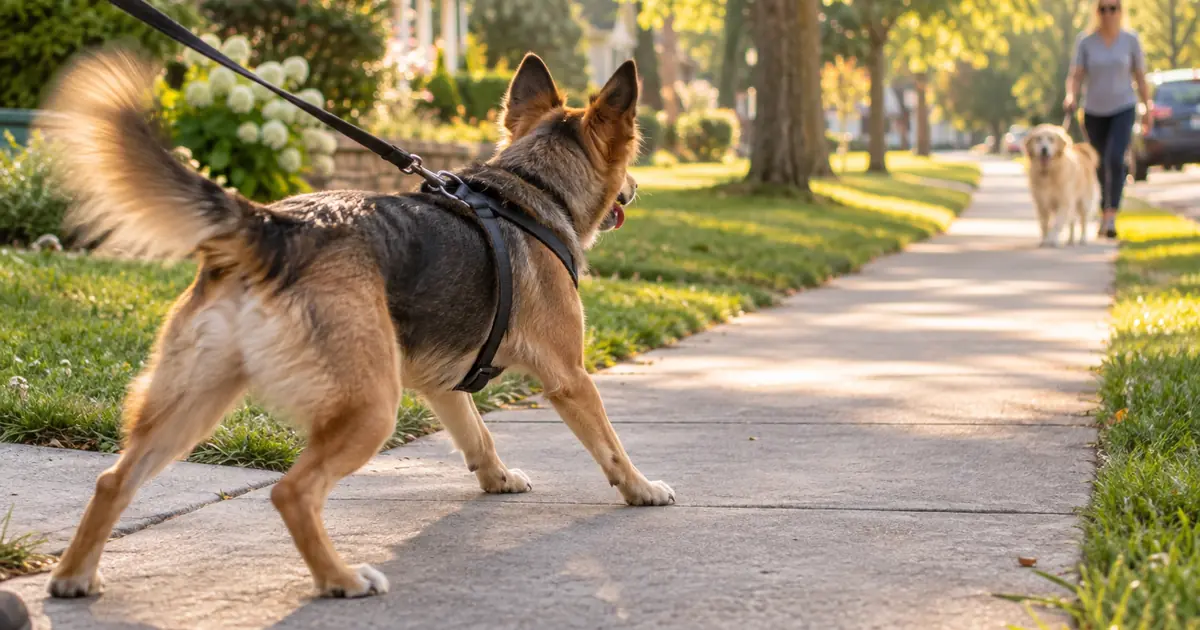
A frustrated greeter is a dog who is socially motivated and wants to interact with other dogs or people, but the leash prevents them from doing so. The frustration builds until it explodes into barking, lunging, spinning, or screaming. Off-leash, the same dog is typically relaxed, playful, and socially appropriate.
This is different from fear-based reactivity. A fearful dog barks and lunges to create distance. A frustrated greeter barks and lunges because they want to get closer. The behaviors look similar from the outside, which is why frustrated greeters get mislabeled as aggressive so often.
The key difference is in the dog's body language. A frustrated greeter typically has a high, wagging tail, forward-leaning posture, and excited vocalizations. A fearful dog has a lower tail, tense body, and may show avoidance behaviors like lip licking or turning away. Understanding which category your dog falls into matters because the training approaches are nearly opposite.
Why the Leash Turns Your Dog Into Someone Else
The leash is the problem. Not the other dog. Not your dog's personality. The physical restraint of being on a leash creates what trainers call barrier frustration.
Picture it from your dog's point of view. They spot a friend across the street. Their brain lights up with excitement. They move forward to greet. The leash tightens. They cannot reach their friend. The excitement has nowhere to go, so it turns into frustration, then explodes.
This pattern strengthens with repetition. The dog sees another dog, anticipates the frustration, and starts reacting before the leash even tightens. The reaction becomes automatic. The dog is not deciding to bark. They are responding to a chain of events that has played out hundreds of times.
Dogs who attend daycare or frequent dog parks are especially prone to frustrated greeter behavior. They have learned that other dogs equal fun. The leash becomes the obstacle between them and that fun. Every walk turns into a series of disappointments.
How to Tell If Your Dog Is a Frustrated Greeter or Fearfully Reactive
Getting the diagnosis right is critical. Here is how to tell the difference.
A frustrated greeter typically:
- Has a loose, wiggly body off-leash around other dogs
- Pulls toward other dogs with a high tail and excited energy
- Stops reacting immediately when the other dog leaves or when they get to greet
- Is often worse on walks near home, where they expect to see familiar dogs
- May have attended daycare or dog parks regularly before the behavior developed
A fearfully reactive dog typically:
- Is tense or avoidant around other dogs even off-leash
- Has a lower tail, pinned ears, or whale eye during encounters
- Takes time to recover after the trigger disappears
- May react more strongly to unfamiliar dogs than familiar ones
- Often has a history of negative social experiences
If you are unsure, film your dog during an encounter and watch it back without sound. Look at the tail, the ears, the overall tension in the body. Better yet, consult a certified trainer who can assess your dog in person. Misdiagnosing a frustrated greeter as fearful and applying the wrong training can actually make the behavior worse.
The Training Approach That Actually Works for Frustrated Greeters
Frustrated greeters want to greet, so the solution is teaching them that not every dog is available for greeting, and that this is fine. The training has two parts: management and behavior modification.
Management: Stop Rehearsing the Behavior
Every time your dog practices the bark-lunge sequence, the neural pathway gets stronger. Your first job is to reduce rehearsals.
- Change your walking route and schedule to avoid peak dog traffic
- Use visual barriers like parked cars or hedges when you spot another dog
- Turn around before your dog notices the trigger, not after they are already reacting
- Consider using a no-pull harness or head halter for better physical control
Management is not a long-term solution, but it is essential in the early stages. You cannot teach new behavior while your dog is in the middle of an outburst.
Behavior Modification: Teach an Alternative Response
The core technique is called counterconditioning with an incompatible behavior. You teach your dog that the sight of another dog predicts something great from you, not an opportunity to greet the other dog.
Here is how it works in practice.
When your dog spots another dog at a distance where they notice but do not yet react, mark the moment with a word like "yes" or a clicker, and deliver a high-value treat. The treat should be something your dog only gets during training sessions, not their regular kibble. Think chicken, cheese, or freeze-dried liver.
The timing matters. You want your dog to associate the sight of the other dog with the treat, not to associate the treat with the other dog leaving. This means you deliver the treat while the other dog is still visible, not after they have passed.
As your dog gets better at this, you gradually decrease the distance. This is called systematic desensitization. You never push so close that your dog goes over threshold. If they start reacting, you have moved too fast and need to increase distance again.
The Critical Skill: Disengagement
Frustrated greeters need to learn that they can look at a trigger and then look back at you. This is called the look-at-that game or disengagement training.
Start in a low-distraction environment. Say your dog's name or make a kissy noise. When they look at you, reward. Once this is solid, practice with mild distractions. Eventually, you can use it when another dog appears. The goal is for your dog to see the trigger, then voluntarily check in with you for their reward.
This skill is transformative because it gives your dog something to do instead of fixating on the other dog. It redirects their mental energy from "I want to greet" to "I should check in with my human."
Why Punishment and Corrections Backfire
It is tempting to correct a frustrated greeter with a leash pop, a verbal reprimand, or an e-collar. After all, the behavior looks aggressive. It is embarrassing. You want it to stop.
But punishment does not address the underlying emotion. Your dog is frustrated because they want something they cannot have. Adding pain or intimidation on top of that frustration creates conflict. The dog still wants to greet, but now they also feel anxious or defensive. This can convert a frustrated greeter into a genuinely fearful or aggressive dog.
Punishment also damages your relationship. Your dog starts to associate the presence of other dogs with negative consequences from you. Instead of learning that other dogs are not always available for greeting, they learn that other dogs predict scary or painful things happening.
Positive reinforcement takes longer at first, but the change lasts and has no side effects. It also builds your bond with your dog instead of damaging it.
The Role of Exercise and Mental Stimulation
Frustrated greeters are often high-energy dogs with active minds. A dog who is physically tired and mentally satisfied is less likely to fixate on every dog they see.
Before training walks, give your dog an outlet for their energy. A game of fetch, a flirt pole session, or a sniffari in a quiet area can take the edge off. The goal is not to exhaust them, but to bring them to a calmer starting point.
Mental stimulation is equally important. Puzzle toys, scent work, and training games at home engage your dog's brain in productive ways. A dog who has worked their mind is less likely to seek stimulation through reactive behavior on walks.
When to Seek Professional Help
Some frustrated greeters improve quickly with consistent training. Others need professional guidance. Consider hiring a certified trainer if:
- Your dog's reactions are getting worse instead of better
- You are unsure whether your dog is frustrated or fearful
- You have tried training on your own for several weeks without progress
- Your dog has injured themselves or you during reactive episodes
- You feel overwhelmed or anxious about walking your dog
Look for trainers certified by organizations like the Certification Council for Professional Dog Trainers (CCPDT) or the International Association of Animal Behavior Consultants (IAABC). Avoid anyone who guarantees quick fixes or relies primarily on punishment-based methods.
A good trainer will assess your dog, explain their diagnosis, and give you a clear training plan with measurable goals. They will also be honest about timeline and expectations. Frustrated greeter behavior typically takes weeks to months to resolve, not days.
What Success Looks Like
Progress with frustrated greeters is rarely linear. You will have good days and bad days. The key is to look for trends over time, not perfection in every moment.
Signs that your training is working include:
- Your dog notices other dogs but does not immediately fixate
- The intensity of reactions decreases, even if frequency stays the same
- Recovery time after a reaction gets shorter
- Your dog voluntarily checks in with you when they see a trigger
- You feel less stressed and more confident on walks
The ultimate goal is not for your dog to ignore other dogs entirely. That is unrealistic for most socially motivated dogs. The goal is for your dog to see another dog, feel a mild interest, and then move on without escalating into frustration.
FAQ
Is a frustrated greeter the same as a reactive dog?
Frustrated greeters are one type of reactive dog, but not all reactive dogs are frustrated greeters. Reactivity is an umbrella term that includes fear-based reactivity, frustration-based reactivity, and predatory reactivity. The training approaches differ significantly depending on the underlying cause.
Can a frustrated greeter become aggressive?
Yes, if handled incorrectly. Using punishment or forcing interactions can create negative associations that convert frustration into fear or defensive aggression. This is why accurate diagnosis and appropriate training methods matter so much.
Should I let my frustrated greeter greet other dogs on leash?
Generally, no. Leash greetings are often tense and unnatural for dogs. The leashes restrict normal body language and can create conflict even between friendly dogs. Teaching your dog to walk past other dogs calmly is a more useful skill than allowing on-leash greetings.
Will my dog grow out of frustrated greeter behavior?
Unlikely without intervention. The behavior is self-reinforcing because the emotional release of barking and lunging temporarily reduces frustration. Each episode strengthens the neural pathway. Consistent training is needed to replace the behavior with healthier responses.
How long does it take to fix frustrated greeter behavior?
With consistent training, most owners see noticeable improvement within four to eight weeks. Full resolution can take three to six months depending on the dog's history, the intensity of the behavior, and how consistently the training plan is followed.
Can I use a prong collar or e-collar for a frustrated greeter?
These tools are not recommended for frustrated greeters. They suppress behavior without addressing the underlying emotion, which can lead to more serious problems. Positive reinforcement-based methods are safer and more effective for this specific behavioral profile.
Does daycare make frustrated greeter behavior worse?
Daycare can contribute to the problem if your dog learns that every dog they see is a potential playmate. However, it is not the root cause. Barrier frustration on leash would still develop in a dog with strong social motivation, even without daycare experience. The solution is training, not necessarily eliminating daycare.
What is the best treat for training a frustrated greeter?
Use high-value treats that your dog only gets during training sessions. Cooked chicken, cheese, hot dog pieces, and freeze-dried liver are popular choices. The treat needs to be more exciting than the other dog, which is why regular kibble usually does not work.
Related Articles
- Dog leash reactivity training guide
- Dog leash reactivity triggers and redirection
- Dog calming signals and stress communication
- Dog body language: ears, tail, and posture
- Dog barking types and communication
- Dog separation anxiety training guide
- Dog enrichment activities for mental stimulation
- Puppy socialization window: critical period guide
Try it with your dog
Record a bark, scan a dog photo, or play a sound and see what happens next.