2026-11-16 · 4 min read
Why Does My Dog Pause at Doorways? Check the Context Before Calling It Stubborn
A pause at a doorway does not automatically mean your dog is being stubborn. Treat it as a clue, not a verdict. Check what changes at the threshold, watch your dog's whole body, and compare the moment with how they move elsewhere. The pause alone cannot tell you whether fear, discomfort, or something nearby is responsible. If it is new and comes with limping, slow standing, trouble on smooth floors, or a broader reluctance to move, arrange a veterinary assessment.
Start with context, not a label
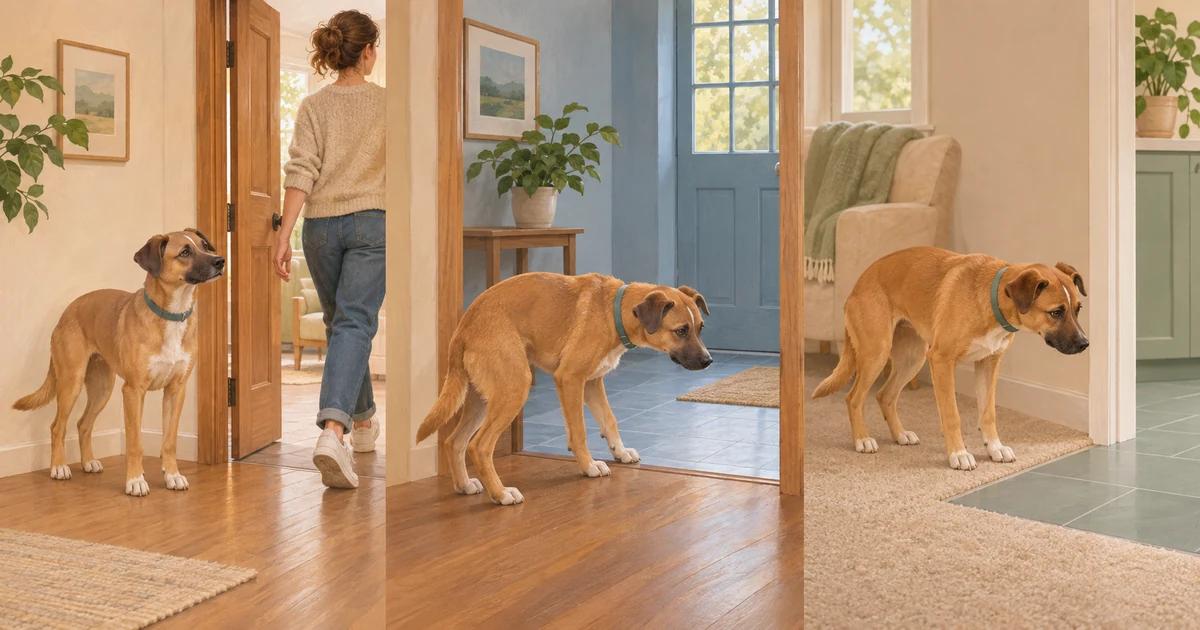
Consider three hypothetical situations. One dog waits with a loose body while someone walks through, then follows. Another lowers their body, trembles, and backs away. A third approaches willingly but stops where carpet meets tile and also struggles to stand after resting. The pause may look similar at first, but the surrounding clues raise different questions.
The American Kennel Club lists shaking, pacing, whining, barking, cowering, and hiding among the ways dogs may express fear. Those signals make uncertainty worth considering, but they do not prove that the doorway itself is frightening. Notice what happened just before the pause and what your dog does when you give them space.
Use a context-first doorway checklist
Start with the exact line your dog will not cross. VCA Animal Hospitals includes avoiding slippery surfaces and difficulty walking on slick floors among possible pain clues. Tile may have nothing to do with the pause, but the surface at the threshold is still worth a closer look.
-
Look closely at the floor transition. Check for smooth tile, a raised strip, a loose mat, moisture, or anything unstable underfoot.
-
Next, scan the space around the doorway for glare, shadows, a moving door, an appliance starting, another animal, or people passing through.
-
Compare different places and times. Does your dog pause at every doorway, only at one threshold, or only under certain conditions?
-
Pay attention to both the approach and the recovery. Note their speed, head position, weight shifts, slipping, or backing away. Then see whether normal movement returns after they leave the area.
-
Recent household changes may matter too, including a removed rug, rearranged furniture, new door hardware, or heavier traffic through the space.
When practical, change one simple condition at a time. You could reduce traffic through the doorway, open the door fully, or place a flat nonslip runner over a smooth transition, making sure it cannot shift. If your dog chooses to cross, note what changed. If they do not, stop instead of repeatedly pressuring them. Either outcome is an observation, not proof of a cause.
Respond without turning the pause into a confrontation
Stop moving for a moment and give your dog room to look, sniff, retreat, or take another route. Avoid dragging the leash, crowding them from behind, or repeatedly waving food across the threshold. Getting your dog over the line still will not tell you why they stopped.
If fear signals keep appearing or the situation becomes unsafe, start with veterinary input. General AKC guidance for persistent fearful behavior also describes gradual behavior modification with suitable professional support. Forcing one crossing does not resolve the underlying pattern.
When the doorway pause belongs with your veterinarian
Arrange a veterinary assessment if the pause is new or comes with limping, slow standing, trouble on slick floors, reluctance to use stairs or jump, reduced endurance, withdrawal, or another change in normal activity. VCA advises bringing possible pain-related behavior changes to a veterinarian's attention because watching at home cannot reveal the cause.
With an older dog, avoid writing off every new hesitation as age. Some slowing is normal, but VCA notes that pain can cause behavior changes in aging dogs. A short video and notes about when the pause happens can help you explain the pattern at an appointment without trying to diagnose it yourself.
Build a better observation habit
Choose one threshold and observe it carefully. Reduce avoidable traffic, check the grip and lighting, and note what happens before, during, and after the pause. Use the dog body language guide to organize what you see. If signs of uncertainty keep appearing, the stress signals guide can help you examine the wider pattern.
The Dog Translator behavior and body-language learning journey is an optional way to learn more about behavioral clues. It cannot turn a single pause into a sentence or diagnosis. If the behavior is new or comes with physical changes, the next step is a veterinary assessment.
Sources
- VCA: Pain and behavior changes in aging dogs
- VCA: Recognizing pain in dogs
- AKC: Common fears and phobias in dogs
Try it with your dog
Record a bark, scan a dog photo, or play a sound and see what happens next.