2026-11-18 · 3 min read
Different Dog Play Styles: How to Tell Whether Both Dogs Still Want to Play
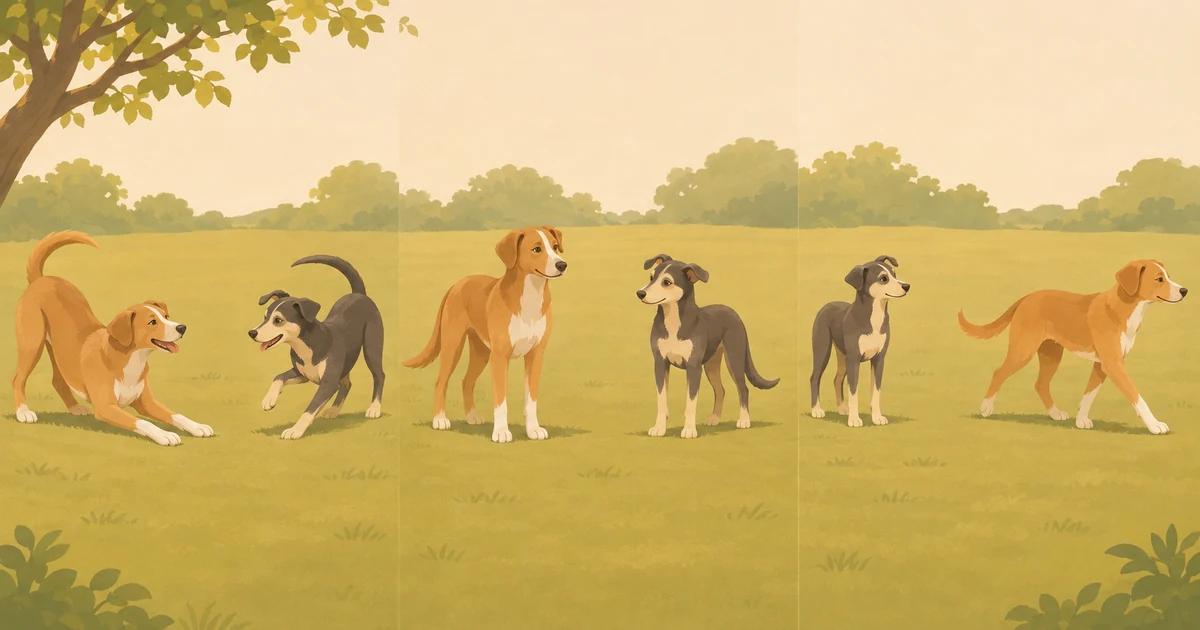
Dogs do not need matching play styles to have a good time together. Watch whether both bodies stay loose, the game can pause and either dog can walk away without being pulled straight back in. A bow, growl, chase or burst of wrestling tells you little on its own. What matters is the pattern over time.
Different play styles are not automatically a mismatch
VCA Animal Hospitals notes that play should suit each dog's preferences and skills. Imagine one dog inviting a fast chase while the other prefers brief contact followed by a pause. That difference alone does not decide whether the interaction works. Look at whether both dogs adjust and whether either can stop taking part.
A single play bow should not outweigh what happens next. Treat it as one piece of the interaction, then keep watching each dog's posture, movement and response. The dog play bow guide looks more closely at this signal.
Signals can be mixed, too. A dog may want to stay while also wanting to retreat, so the moment may not fit neatly into a playing-or-not-playing label. If you cannot read the situation clearly, give the dogs more room instead of forcing a confident interpretation.
Use a four-question comfort check
Rather than keeping score of individual behaviors, come back to four practical questions. Taken together, the answers tell you more than any one bark, bow or chase.
-
Are both dogs loose enough to bend, turn and change direction, or are they becoming still and rigid? The RSPCA describes relaxed posture together with a relaxed mouth, naturally positioned ears and normally shaped eyes.
-
During a brief pause, does each dog have a real chance to return or leave? Choosing to re-engage is useful information, but it does not guarantee that the next moment will stay comfortable.
-
Can both dogs wind down and step away? VCA warns against play that causes excessive arousal, since a dog may then struggle to settle or leave the game when asked.
-
Is either dog showing several signs of discomfort, such as a lowered posture, tucked tail, ears held back, lip licking or avoiding eye contact? The dog stress signals guide can help you consider these clues without treating one gesture as a fixed translation.
How to use a brief pause
If you are unsure, interrupt before the interaction becomes harder to manage. Use familiar cues from a safe distance, or ask separate handlers to call the dogs apart. Once they have space, watch what each dog chooses instead of restarting the game right away.
If both dogs stay loose and independently choose to return, it may be reasonable to let supervised play continue. Keep watching, since re-engagement is only one clue. End the interaction if one dog stays away, keeps a low or tucked posture or repeatedly tries to make space instead.
A pause is neither a diagnosis nor a promise that the dogs are safe together. It simply gives you a chance to see whether both dogs still have a choice.
When to end the game
End the interaction if either dog cannot disengage, becomes stiff and forward, stays low and tucked or shows increasing distress. Give them space before the situation turns into a dramatic confrontation.
If a fight has started, separate the dogs safely without putting your hands or body between them. This article does not cover fight-breaking techniques. If interactions are repeated, escalating or difficult to manage, speak to your veterinarian. They may refer you to a clinical animal behaviorist.
The useful next step
At the next play session, watch the whole interaction and pause it briefly whenever you are unsure. Loose movement, the ability to wind down and each dog's choice to return or leave mean more together than any single signal. If either dog cannot opt out comfortably, end the session and give them space.
Sources
- VCA canine communication guide
- VCA dog play and exercise guide
- RSPCA dog body language guide
Try it with your dog
Record a bark, scan a dog photo, or play a sound and see what happens next.