2026-07-03 · 6
Puppy Potty Training for Apartment Living: Complete 2026 Guide
Potty training a puppy in an apartment presents unique challenges. You cannot simply open a back door and let them run outside. Elevators, hallways, and weather all complicate the process. But thousands of apartment dwellers successfully house train their dogs every year. This guide shows you exactly how to join them.
The principles remain the same regardless of housing type. Consistency, positive reinforcement, and patience produce results. Apartment training just requires more planning and structure. You need a schedule that accounts for your building's layout and your puppy's small bladder.
This guide covers everything from setting up your space to troubleshooting common problems. By the end, you will have a clear plan for getting your puppy potty trained without losing your security deposit or your sanity.
Why Apartment Training Differs from House Training
Suburban puppies often have immediate outdoor access. A door opens to grass within seconds. Apartment puppies face a journey: crate to door, door to elevator, elevator to lobby, lobby to street. That journey takes time a small bladder does not have.
Weather adds another layer. Rain, snow, extreme heat, or cold create resistance. A puppy who hesitates in bad weather has fewer options in an apartment. You cannot just try again in ten minutes without significant effort.
Noise and distractions also differ. Hallways echo with footsteps and voices. Elevators contain strangers. The street outside has traffic, other dogs, and countless smells. These stimuli can overwhelm a puppy who is supposed to be focusing on elimination.
Understanding these differences helps you prepare. Apartment training is not harder, just different. It requires anticipating problems rather than reacting to them.
Setting Up Your Apartment for Success
Before your puppy arrives, designate specific areas. You need a sleeping area, a feeding area, and a potty area. These should be separate. Dogs naturally avoid soiling where they sleep, but if everything happens in one corner of a studio apartment, accidents become inevitable.
For the potty area, you have three main options. First, outdoor only: you take your puppy outside every time. Second, indoor transition: you use pee pads or a grass patch indoors initially, then transition outside. Third, permanent indoor solution: you maintain an indoor potty area indefinitely.
Most trainers recommend aiming for outdoor only if possible. It creates clearer communication and avoids the confusion of teaching two acceptable spots. However, high-rise dwellers on upper floors sometimes use indoor options for overnight or emergencies.
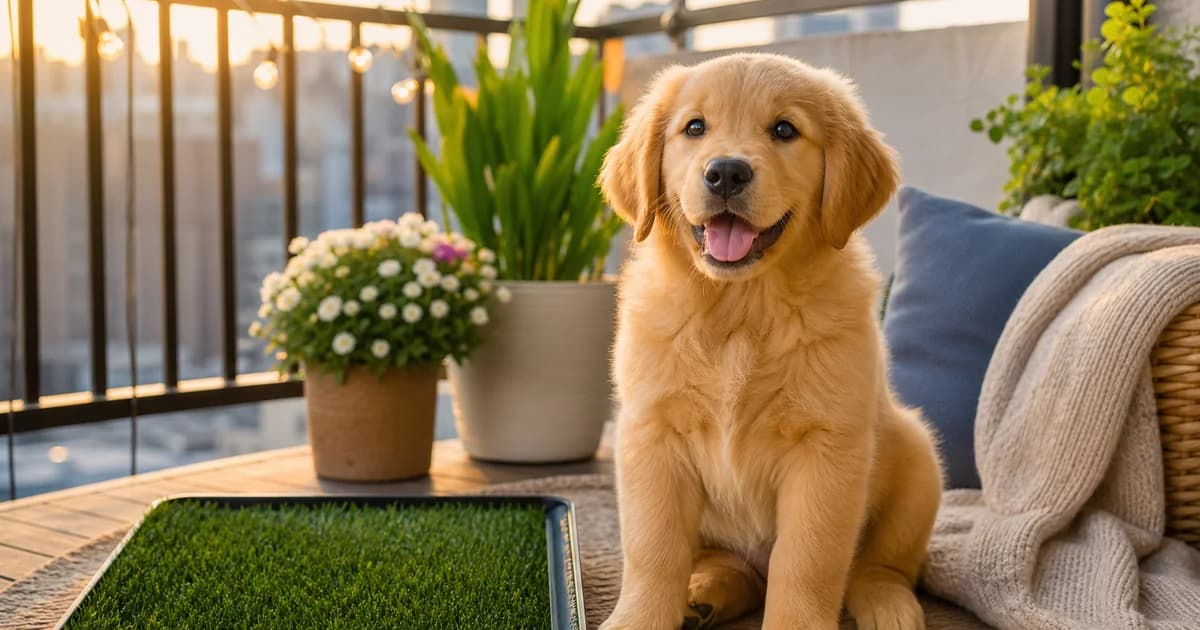
If you choose indoor training aids, place them away from food and bedding. Use a specific surface, like a grass patch or pad holder, rather than loose pads that slide around. Consistency in location matters as much as consistency in timing.
The Schedule That Actually Works
Puppies need to eliminate after waking up, after eating, after playing, and after any excitement. They also need regular opportunities based on age. A two-month-old puppy cannot hold their bladder longer than about two hours during the day.
Here is a sample schedule for an apartment dweller with a three-month-old puppy:
Morning: Wake up, immediately carry puppy to potty spot. Praise and treat if they go. Return for breakfast. Fifteen minutes after eating, potty break again.
Mid-morning: Potty break every two hours. If you work from home, this is manageable. If you leave, you need a dog walker or puppy sitter.
Lunch: Same pattern as breakfast. Food, wait fifteen minutes, potty break.
Afternoon: Continue every two hours. Watch for signals: circling, sniffing, whining, or sudden stillness.
Evening: Dinner follows the same routine. Limit water intake two hours before bed to reduce overnight needs.
Night: Most puppies need one overnight break until four or five months old. Set an alarm or let them wake you.
Reading Your Puppy's Signals
Puppies communicate before they eliminate. Learning these signals prevents most accidents. Watch for:
Circling: Walking in tight circles while sniffing the ground. This is the most reliable indicator.
Sudden stillness: Stopping play abruptly and standing still. Often accompanied by a distant look.
Sniffing: Intense investigation of a specific floor area, different from casual exploration.
Whining or scratching: Vocalizing or pawing at the door if they have started learning the routine.
When you see any of these signals, act immediately. Pick up your puppy if necessary and get to the designated potty spot. Speed matters more than elegance.
The High-Rise Challenge: Elevators and Stairs
If you live above the second floor, you need a plan for getting outside quickly. Elevators take time. Stairs might be faster but require more effort. Decide your route before you need it.
For elevator buildings, consider these strategies. Time your trips to avoid waiting. Many puppies cannot hold it through a long elevator delay. If possible, use a service elevator or less busy bank of elevators during training.
Some owners use a carrier or sling for the journey. This prevents accidents in hallways and elevators. It also keeps your puppy contained during the chaotic transition from inside to outside.
Stairwells present different issues. They are often concrete, echoey, and smell of other dogs. Some puppies eliminate in stairwells because the smells trigger the behavior. If this happens, clean thoroughly with enzymatic cleaner and consider the carrier method until training solidifies.
Positive Reinforcement That Works
When your puppy eliminates in the correct spot, reward immediately. Timing matters more than the size of the reward. The praise or treat must come within two seconds of finishing. Any delay, and your puppy will not connect the reward to the action.
Use a specific phrase as they eliminate. "Go potty" or "Do your business" work well. Say it calmly every time. Eventually, you can use this phrase to prompt elimination on command, useful before car trips or vet visits.
Keep rewards high-value during training. Small, soft treats work best. You want something the puppy can eat quickly without leaving the potty area. Save the best treats for potty training and use lower-value rewards for other behaviors.
Never punish accidents. Punishment creates fear and confusion. Your puppy might learn to hide when they need to go, making training harder. They might associate your presence with fear, damaging your bond. Simply clean up and watch more carefully next time.
Cleaning Accidents Properly
Enzymatic cleaner is essential. Regular household cleaners remove visible stains but leave scent molecules that attract dogs back to the same spot. Enzymatic cleaners break down the organic compounds completely.
For carpets and upholstery, blot first, then apply cleaner liberally. Let it sit for the recommended time, usually ten to fifteen minutes. Blot again and let air dry. Repeat if any odor remains.
Hard floors are easier but still require thorough cleaning. Urine can seep into grout and under baseboards. Clean beyond the visible stain to ensure complete odor removal.
If your puppy keeps returning to the same accident spot, change the association. Feed them there, play there, or place their bed there temporarily. Dogs rarely eliminate where they eat or sleep.
Troubleshooting Common Problems
My puppy goes outside then eliminates inside immediately after.
You are not staying outside long enough. Puppies often need to go multiple times per trip. Wait until you see a second elimination or ten minutes pass without activity.
My puppy only uses pee pads sometimes.
Inconsistent location confuses puppies. Move the pad to where accidents happen, then gradually shift it to your preferred location over several days. Or switch to a different surface that feels more distinct from your flooring.
My puppy wakes me up multiple times per night.
Ensure they are actually eliminating when you take them out. Some puppies learn that waking you means going outside, which becomes a game. If they do not eliminate within five minutes, return to bed without play or excitement.
My puppy eliminates in their crate.
The crate might be too large. Dogs avoid soiling where they sleep, but only if the sleeping area feels defined. Use a divider to make the crate just large enough for standing, turning, and lying down.
My puppy was doing great but regressed.
Regression is normal after changes: new home, new schedule, illness, or stress. Return to the basics: more frequent trips, closer supervision, and consistent rewards. Most regressions resolve within a week.
When to Seek Professional Help
Most puppies achieve reliable potty training by six months. If your puppy still has frequent accidents after this age, consult a veterinarian first. Urinary tract infections, digestive issues, or other
Try it with your dog
Record a bark, scan a dog photo, or play a sound and see what happens next.